
On September 15, the Clarity Act received only 49 of the 60 votes it needed to advance in the Senate. After months of negotiations, comprehensive crypto market-structure legislation now appears out of reach.
We’re now just over one month out from the fateful vote, but founders still have reasons to be optimistic about how things are unfolding. The SEC and CFTC are moving ahead with rules that, if finalized, should make it easier to raise capital, launch products, and operate in the United States. After years of regulation by enforcement, we are finally getting clarity (albeit this time, with a lowercase “c”).
The challenge here is reversibility, since a future administration could still change or repeal these rules. But in the absence of legislation, our best bet is for agencies to finalize appropriately tailored rules and build a market that makes them harder to undo. Then, the more useful things founders build under those rules, the harder it will be for a future administration to justify reversing them.
Here is a rundown of where things stand as of October 22, 2026, including key guidance from before and after the vote on Clarity.
This is meant to provide a broad overview and is not legal advice. Founders should work with their legal counsel to understand what these developments mean for their businesses.
| Development | Date issued | What it is | Binding or nonbinding? |
| SEC interpretation and CFTC guidance | March 17, 2026; effective March 23 | The agencies’ interpretation of how existing law applies to crypto | Nonbinding interpretation. Explains the agencies’ position but does not bind courts. |
| Regulation Crypto Assets (aka “Reg Crypto”) | August 18, 2026 | Proposed fundraising exemptions and a safe harbor for ending investment-contract status | Not binding or available in final form yet. The SEC must adopt final rules. |
| SEC Innovation Exemption | September 17, 2026 | 5-year exemption from exchange registration for qualifying stock AMMs and dealer registration for qualifying liquidity providers | Available now, subject to the order’s conditions and time limit. |
| SEC Crypto FAQs | September 25, 2026; updated September 28 | Staff answers on token classification and issuer promises | Nonbinding staff guidance. Not a rule or Commission-approved position. |
| Regulation CTX and Regulation CAM | October 5, 2026 | Advance notice exploring rules for retail crypto transactions offered with leverage or financing and a tailored federal exchange framework | Not binding or available yet. An advance notice seeking input before proposed rule text and final rules. |
Here are developments founders should understand, and how they change the regulatory landscape for building:
1. The SEC is placing more weight on team promises.
Crypto founders know and love the Howey test: a transaction is an investment contract security when buyers invest money in a common enterprise with a reasonable expectation of profits from others’ essential managerial efforts. The crypto industry’s focus on the “essential managerial efforts” prong helped make progressive decentralization the standard playbook; teams distributed control over their networks to reduce buyers’ dependence on the founding company. We’ve argued that this approach has handcuffed founders’ ability to execute on their businesses.
The SEC’s March interpretation appears to put less emphasis on progressive decentralization as a general playbook and instead pin the crux of the analysis to the promises made by the team before or at the time of sale. The key takeaway is that founders should be extremely vigilant about their communications and specifically the promises they make to current or prospective token buyers before or at each sale, because they can dictate whether a token sale is treated as a securities offering and whether securities laws continue to apply to subsequent sale.
The interpretation states that these promises are what issuers will be held to when determining whether there is a live security in play — if these promises are fulfilled, or the project has clearly wound down, there is likely no longer an investment contract, because there is no reasonable expectation that a manager is carrying out the enterprise. Founders will need to toe the line: laying out ambitious plans for how they will use the money that appeal to investors, while keeping those promises sufficiently attainable. Otherwise, they risk prolonging the investment contract longer than necessary, restricting how the token can be used (or at least leaving its regulatory status less clear.)
2. Buybacks can avoid investment-contract treatment, so long as they are not centrally controlled.
The SEC’s September FAQs also address how token buybacks impact the securities analysis. They say that if the system is “functional and has no central party” then announcing a buyback wouldn’t amount to a promise that could create an investment contract. If the system is not “functional”, pitching the buyback as a source of return could amount to such a promise.
To be honest, it’s not entirely clear to us what the agency staff means by “functional” here or how that fits with an issuer announcing a buyback when there is no central party. Our best guess is that the staff is making a distinction between programmatic buybacks and burns vs. purchases a team actively manages. The latter arguably involves some managerial control, and therefore would give holders more reason to rely on the team’s efforts. However, the FAQs do not expressly draw this distinction, and they leave open how buyback announcements should be treated when a system is live but still has a central party.
The takeaway is that founders should optimize for programmatic buybacks. Not only does this provide more certainty for the market to conduct a DCF analysis, but it also creates a stronger regulatory posture that there is no security at issue.
3. Token fundraising in the U.S. could become much easier through Reg Crypto.
The proposed Regulation Crypto Assets, or “Reg Crypto,” would create two exemptions for certain token sales involving investment contracts (but not for tokenized equity or debt). Neither exemption is available yet, but here are the latest proposed terms (though they are nowhere near final):
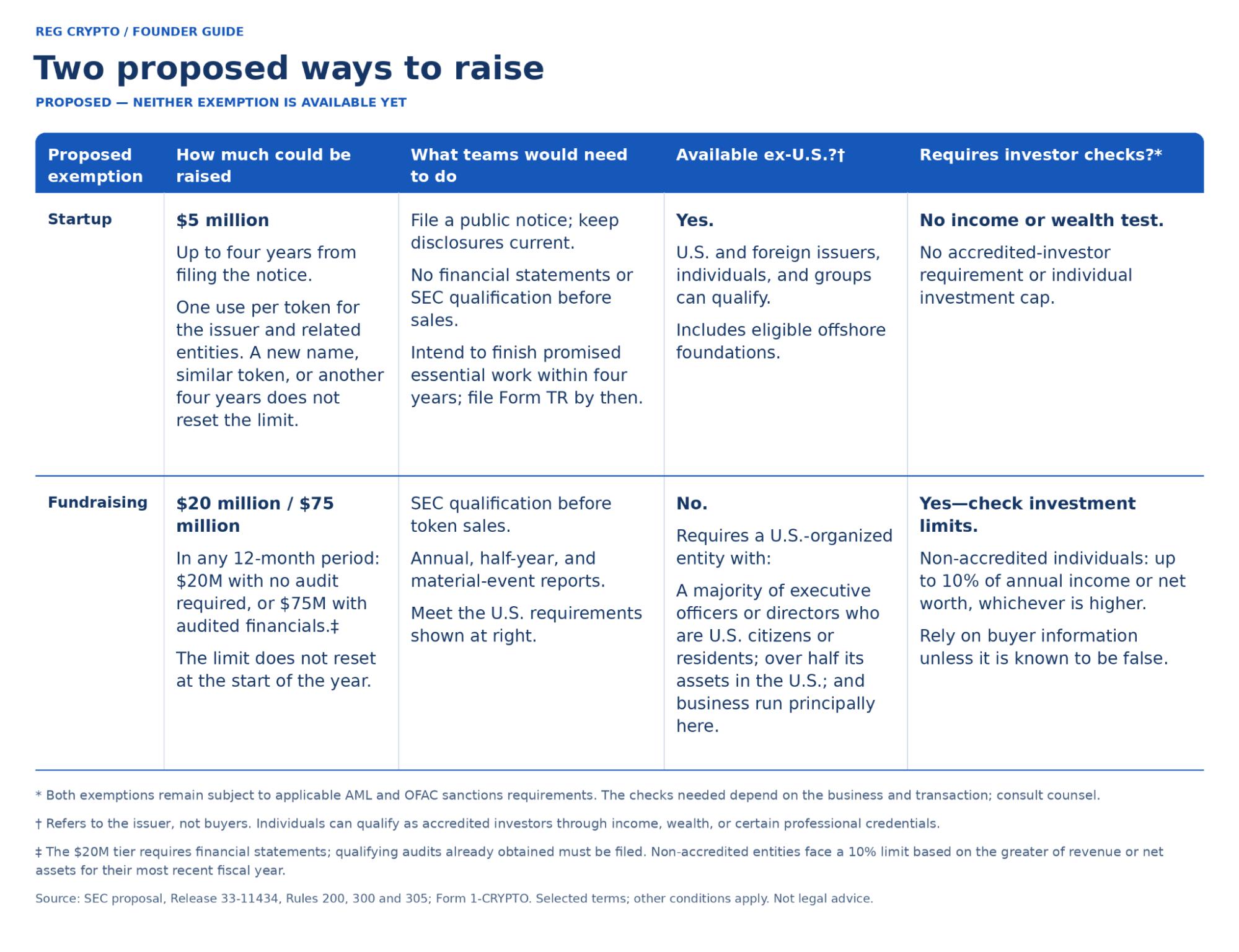
Founders should choose a path based on how they want to raise from users, not just their total fundraising target. For example, a team raising $10 million might raise $8 million from VCs under Regulation D and $2 million from users in a token fundraise under the startup exemption, assuming it meets the rules for combining offerings. This hybrid fundraise could let users buy in without the reporting burden of the larger fundraising exemption.
The startup exemption also comes at an interesting time: AI is making businesses cheaper to build and launch. More “weekend entrepreneurs” may be able to turn a side project into a business with a small team and a modest raise. Not every company’s capex needs will fit into the constraints of the startup exemption, but for those that do, a $5 million token fundraise could provide the runway to start building.
This is especially exciting news for community fundraising platforms like MetaDAO, where teams raise through token sales and use markets to govern project decisions. Cheaper development and a workable U.S. token fundraising exemption could make it easier to start small and raise from early users and supporters.
4. Crypto exchanges could get a tailored registration pathway from the CFTC.
On October 5, the CFTC asked for input on two frameworks: Regulation Crypto Asset Transactions (Reg CTX) and Regulation Crypto Asset Markets (Reg CAM). This is only an advance notice of proposed rulemaking—the agency is gathering input before drafting proposed rules. Both are earlier in the process than Reg Crypto, and the details will change substantially, but the notice gives an early sense of what the CFTC has in mind:
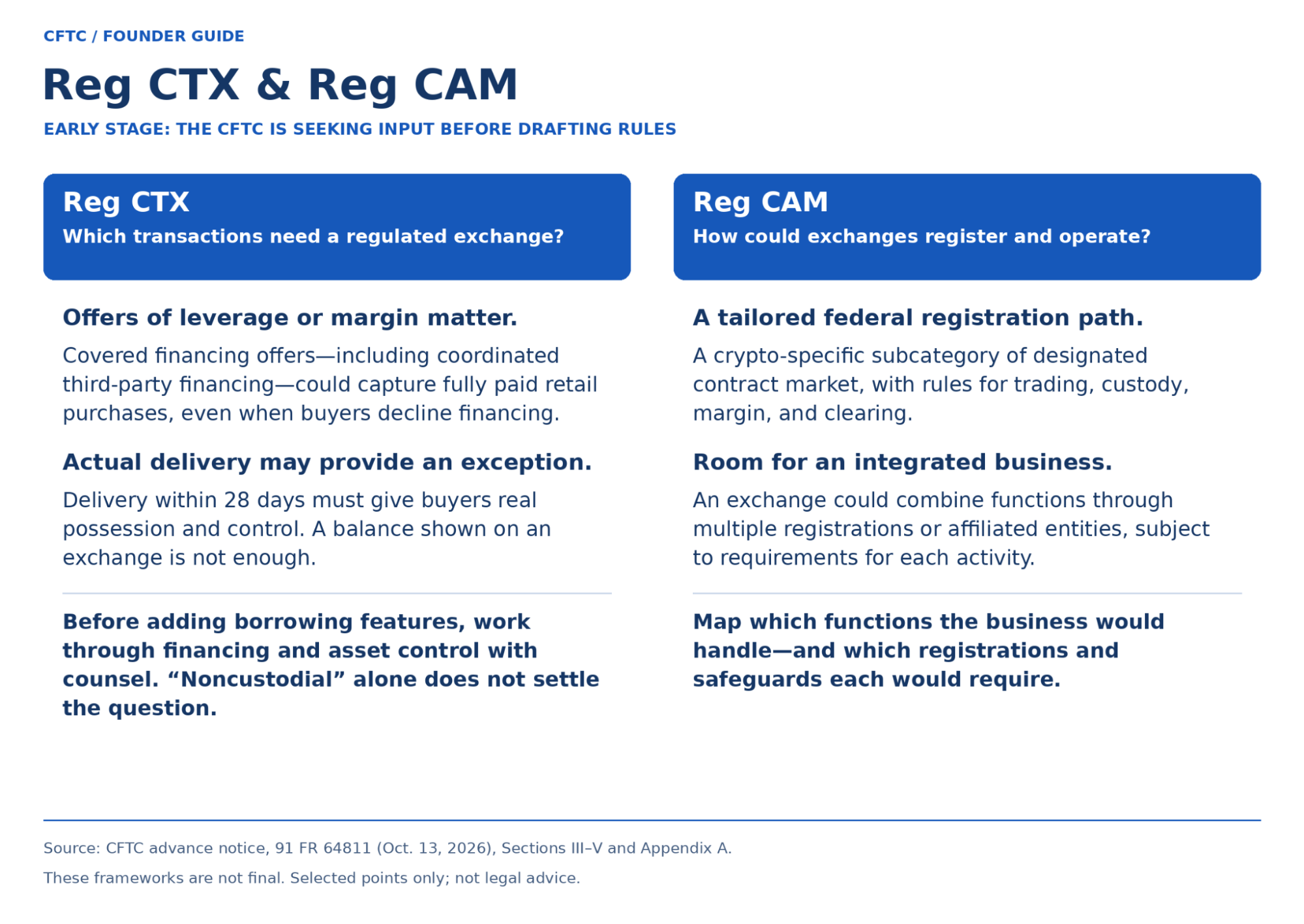
- Reg CTX concerns which trades have to happen on a regulated exchange. Offering financing (either directly or through a third party) could bring a retail transaction within these requirements, even if the buyer turns this financing down and instead pays in full. One possible exception is actual delivery within 28 days, but crediting a buyer’s account is not enough: the buyer needs meaningful possession and control of the assets. T
- Reg CAM concerns how exchanges handling those trades could register. The CFTC is considering a crypto-specific subcategory of its existing designated contract market registration, with requirements adapted for trading, custody, margin, and clearing. It also contemplates exchanges combining those functions through multiple registrations or affiliated entities, with requirements for each.
The new framework may take time founders should be tracking how these regulations evolve, particularly if they’re considering adding margin or leverage features (either directly or through third parties). Founders work through the technical logistics of these features with counsel to be best positioned to qualify for the exemption when the time comes (if applicable).
Why now is the time to build
These developments give founders a reason to revisit plans they may have shelved during the era of regulation by enforcement. The proposed rules could make raising from users or serving U.S. customers feasible for the first time.
Reg Crypto could change before adoption, and Reg CTX and CAM are even earlier in the process than that. Founders should be careful about making plans that depend on today’s proposals passing unchanged. But there is plenty to do now: use the guidance and relief already available, assess what the proposals would mean for their businesses, and weigh in, if desired, while the details are still being decided.
Our DMs are open to founders who want to think through any of these updates and what they might make possible.