
This month, Anthropic asked the AI industry to slow down. In a report on its own models, the company said the world should build a way to “slow or temporarily pause frontier AI development,” warning that AI was starting to improve itself. It is the most valuable lab in the world and is preparing to go public, and a coordinated slowdown would also coincidentally hold its competitors in place while it sits in front.
When the mission and the money point the same way, as with Anthropic’s slowdown call, acting on the mission is straightforward. Anthropic is a public benefit corporation (or “PBC”), as is OpenAI, which converted its for-profit arm into a PBC in October 2025. The PBC is the legal form frontier labs now reach for to signal that the mission comes before the money. Labs adopt the PBC structure for two audiences in particular. First, regulators take the labs at their word: when a company warns about its own technology, the way Anthropic just did, the mission becomes something the government can hold it to. That same mission reassures the talent the labs recruit: Jan Leike resigned as co-head of OpenAI’s safety team in 2024, wrote that safety had “taken a backseat to shiny products,” and moved to Anthropic.
The real test of these structures is not what a lab does when the mission is free, or even profitable, but what happens when the mission costs it something. On that test, the PBC alone barely binds the company to its mission.
This piece is about why the PBC fails on its own, and what a founder who wants the mission to survive can build instead. The short version: a PBC charter names a mission but does almost nothing to keep a company to it once keeping it gets costly. The protections that actually hold are a mission veto a board can’t quietly remove, and control held by a body that doesn’t profit from a sale. No lab has built both, and most have built neither. A founder still can, but the window is early, while control is cheap to give up and the structure can go into the company before later rounds make it harder to add.
I. Why the PBC Alone Doesn’t Bind
A PBC is an ordinary for-profit with three major tweaks:
- The charter names a public benefit.
- The directors have to weigh that benefit, and the people the company affects, against shareholder returns.
- At least every two years, the company has to give its shareholders a written report on how it pursued the benefit — a report that stays private and that no outside body has to review.1
Beyond that, it is a normal company: shareholders elect the board and can drop the public-benefit status by a simple majority.
The PBC exists because, in an ordinary corporation, the law will not let directors put a mission ahead of shareholder returns. The clearest illustration is Craigslist: when its founders used a poison pill to keep the site mission-driven and block minority shareholder eBay from monetizing it, the Delaware Court of Chancery struck the pill down in 2010, holding that directors of a for-profit cannot protect a “culture” at shareholders’ expense.2
The PBC carves out an exception from that rule, meaning a company can name a mission in its charter and direct its board to weigh it alongside profit. The trouble is that the exception is weak in three ways:
- No one enforces adherence to the mission. Delaware only checks that the board considered the public benefit, not whether it weighed it correctly. Going through the motions is enough, and the public the mission serves has no standing to sue.3 The one suit that tried, Musk against OpenAI in 2024, was dismissed in 2026 as too late, without any ruling on whether the mission binds. There’s still no precedent to guide founders.4
- The mission is usually too vague to enforce. Veeva, the first public company to convert to a PBC, promises in its charter to make the industries it serves “more productive.” Vital Farms lists six public benefits, one of which is “bringing joy to our customers,” and another of which is simply running a profitable business. Good luck having a court hold a board to any of that.
- Companies engineer around it. In OpenAI’s 2023 board crisis, the nonprofit board fired Sam Altman. Five days later, he was back, the directors who fired him were gone, and the board’s power against Altman went with them. None of that reversal required changing the formal structure.
II. The Two Controls That Work
None of this means the PBC is inherently doomed as a foundation for mission-driven governance. The PBC is new – it first appeared in Maryland in 2010 and Delaware in 2013 – so it has almost no track record. The problem it tries to solve, however, is old, and we can look at they controls successful companies in similar structures have used to give the public benefit real teeth:
Separate control from the money
The first tool is to separate the mission body’s control from the financial upside of the affiliated profit-seeking enterprise. This usually takes the form of a trust or foundation that holds the board votes but has little or no equity in the profit-seeking enterprise. A few companies have built exactly that:
- Patagonia put all of its voting stock in a purpose trust that holds just 2% of the equity; the other 98% sits in a nonprofit that funds climate work. Because the trust holds the votes and the nonprofit holds the economics, no one who controls Patagonia has a financial reason to sell it or stray from the mission.
- Novo Nordisk is controlled by a foundation holding about 77% of the votes but only 28% of the equity, with the rest trading publicly. The control shares can’t be sold; the foundation’s own charter forbids it. At one point the company was Europe’s most valuable, built by shareholders who bought in knowing control would never be theirs.
Separating control from money has a cost, though. The same lock that keeps an owner from selling also means that if the controlling body itself goes wrong, no shareholder has the votes to remove it.5 The design has to settle not just whether control is separated from money, but who holds it and how they can be removed.
Use specific language for both the mission and the veto
A court can only enforce what it can read and check against the facts, so the mission and the veto have to be specific, and they have to live in the charter, the one document the board can’t quietly rewrite on its own.6 This isn’t a stylistic point. In the fifteen years since the first PBC statute, no court has held a company to its public-benefit mission. Part of the reason is that the missions are written too broadly for any fact to prove a breach, and part is that the law itself makes them hard to enforce: directors owe no duty to anyone on account of the mission, only shareholders above a size threshold can sue, and the only remedy is an order to change course, not money.7
Start with the mission. The trap is writing one the company can always claim it met. A purpose like “advance human well-being” binds no one, because no fact could ever show the company fell short of it; most public benefit corporations write exactly this kind of unfalsifiable mission.8 A lab should write a mission a court could measure – for example, to deploy frontier models only after a named safety evaluation, or keep a defined class of capability out of released products.
The veto is different. The danger there isn’t vagueness, it’s settling for a say instead of a stop. A right to be consulted before a model release lets the board listen and proceed anyway; only a right to block the release actually holds. A lab should give the mission body the power to halt specific actions, a sale of the company, a model release once a defined risk threshold is crossed, written so a court can see whether the trigger was met and whether the company moved regardless.
None of that matters, though, if the company can just get rid of the people holding the veto. Ben & Jerry’s is the case to learn from. When Unilever bought it in 2000, the deal gave an independent board real power to defend the brand’s social mission, basically a standing veto over anything that would gut it, and for twenty-five years it held. What nobody locked down was who got to sit on that board. So in late 2025, when Unilever spun the business off into a new company called Magnum, Magnum decided the independent directors no longer qualified and removed them. The veto language held strong; what failed was that the people holding it could be removed.
III. What AI Labs Have Built
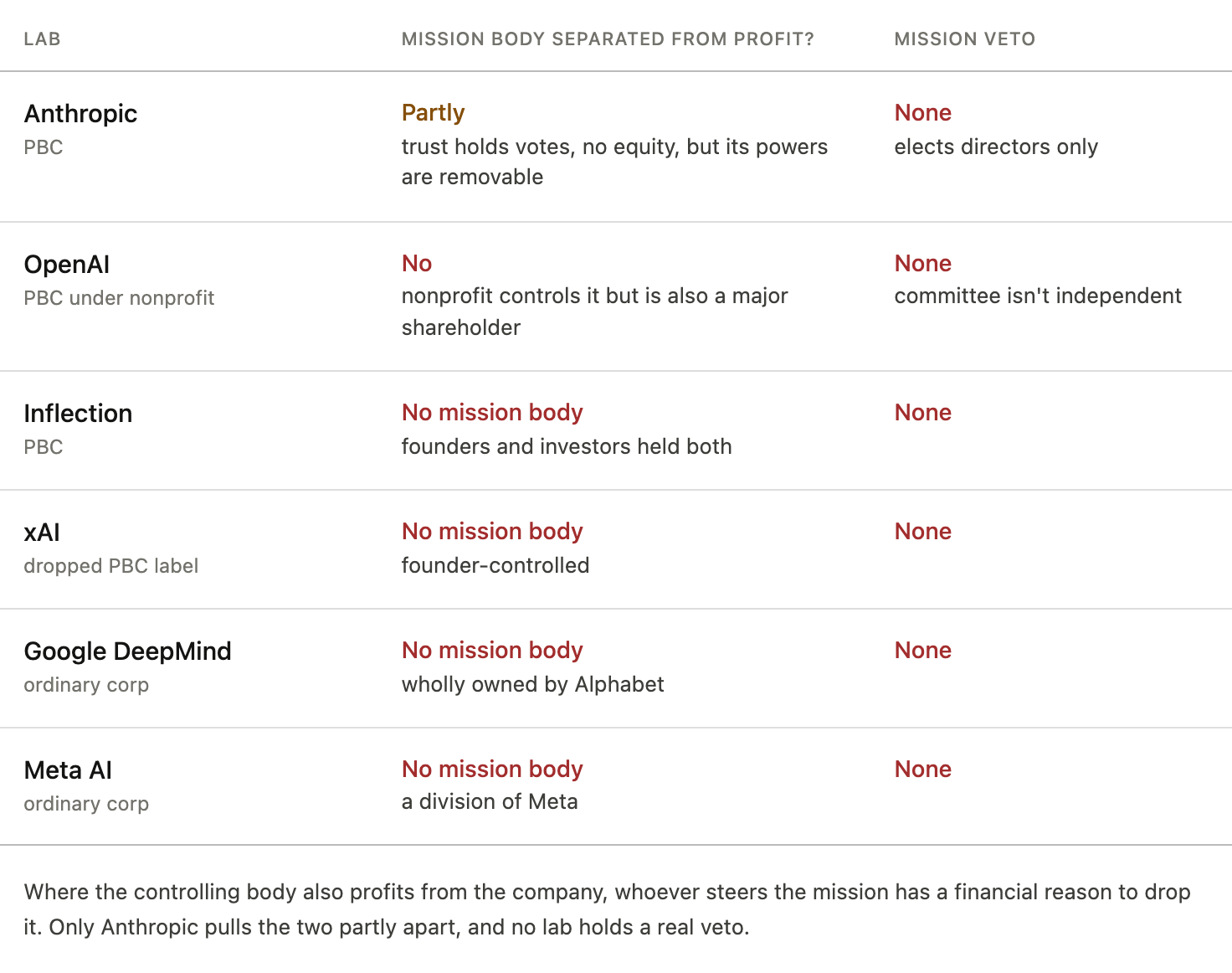
Only a few of the labs even adopted the PBC. Meta and Google run their frontier work inside ordinary corporations, so mission controls never come up. xAI took the public benefit label in 2023 and dropped it within a year.9 Unfortunately, even the labs that adopt the form struggle to implement these two controls, which lets the mission slip:
- Inflection had their mission walk out with the people. Control and equity sat with the founders and their investors, the same people who stood to gain from a sale, and there was no mission body to object. So when Microsoft hired away the CEO and most of the staff in 2024, the people holding both the control and the money took them along, and the PBC shell was left behind with its promise to improve “human well-being and productivity.”
- OpenAI is controlled by the same body that profits from it. Its nonprofit controls the for-profit, but the nonprofit is also one of the for-profit’s largest shareholders, with a stake worth on the order of $130 billion, so the body holding control is also a major beneficiary of the company’s commercial success. The richer the company gets, the richer the nonprofit gets, even though the nonprofit’s job may sometimes require the company to give up revenue.The veto has the same problem. A safety committee at the nonprofit can in principle halt an unsafe release, but it isn’t independent of the managers it is meant to check, as the 2023 board crisis showed.
- Anthropic has separated control from money, but only partway. Its Long-Term Benefit Trust in theory separates mission from profit; it has five trustees with no equity who now elect a majority of the board, and no other leading frontier lab has built out this governance infrastructure. But a large enough group of shareholders can rewrite the Trust’s powers without the trustees’ consent, and the thresholds have never been published, so how much it binds can’t be confirmed from outside.10 As for veto power, the Trust has none where it matters most: it elects directors, but appears to hold no right to block a release or a transaction.11
IV. What Founders Should Do: Pursue a Progressive Public Benefit
It’s no surprise none of the labs have done this. The mission needs serious capital, and capital expects a say in how the company is run. The controls cut the other way: give a mission body real control, or a specific veto the board can’t strip, and every future investor has less say, which makes raising harder. The ones who pulled it off could afford to. Patagonia put its stock in a trust because its founder had never taken outside money; a lab raising billions can’t do that on day one without scaring it off.
The way through is to phase it in: hold control early, then hand it over in stages as the company matures. Crypto runs this playbook under the name progressive decentralization – admittedly with mixed results. Empirical studies of major DeFi protocols find that governance frequently remains concentrated even after control is nominally distributed to token holders, with voting power held by a small set of large holders. Ethereum, however, is an example of a case that worked: its founders gave up control in stages until no company owned the network or could change its rules, which is why banks, startups, and ordinary users now move billions through it.12 The lesson for a lab is the same: phasing only protects a mission if the later stages are written down and hard to reverse, not left to the goodwill of whoever holds power when the moment comes.
So here is the hard part, and as a fund that writes these checks, we’ll say it plainly: each of these controls can make a company harder to finance. The thing that protects a mission from investors, control they can’t reach, is the same thing investors are paying to get. This means that the question for a founder building a mission-driven frontier lab isn’t just which control is strongest on paper, it’s how much of it the company can carry at each stage without starving itself of capital.
Most frontier labs don’t choose how hard to protect the mission. They accept whatever the PBC alone provides, which is very little. For context, across all nineteen public benefit corporations trading on U.S. markets, only four required a heightened vote to weaken their own stated mission, though nearly all of them required one to change other parts of their charter.13 A founder who wants to do better has a range of structures to choose from, ordered by how hard they bind the mission and how much they cost to raise against:
- A charter provision requiring a heightened vote to change the mission. This is the cheapest structure to implement, and the one investors already use to protect their own terms, so it costs almost nothing at the term sheet. Its limit is that it governs only a formal charter change; without careful drafting a board can step around it through a merger or a reincorporation, as the Delaware Court of Chancery allowed when it let The Trade Desk shift to Nevada on a simple majority because the supermajority clause didn’t say it applied.14
- A mission body with a veto, in its own share class. This is a bigger ask: a party outside management can block a sale or a release, roughly Anthropic’s structure.15 Investors accept a bounded veto over a defined list of actions more readily than an open-ended one, but it narrows the buyer pool at exit and holds only if the seats are locked down. Ben and Jerry’s is the warning: the veto language survived the 2000 sale to Unilever and lasted twenty-five years, but the independent directors who held it were removed once the business was spun off.16
- Voting control in a foundation that holds little of the economics. This is a real financing cost, because the people steering the company no longer answer to the people who funded it. Novo Nordisk runs this way: a foundation holds about 28% of the equity but roughly 77% of the votes, in shares that can’t be sold.17 Hershey is the sharper case, where a trust controlling the votes on a sliver of the equity has twice refused premium takeovers.18 Venture’s reflex is that locking control this way guarantees a lazy, value-destroying company. The evidence runs the other way: foundation-owned firms match comparable investor-owned firms on profitability, take less risk, and survive markedly longer.19 What they give up isn’t performance. It’s the exit.
- A perpetual purpose trust that takes the company off the market entirely. This is the Patagonia structure, and the one genuinely incompatible with conventional venture math, because there’s no liquidity event at the end of it.20 It works when a founder can self-fund the mission, and seldom otherwise.
A founder need not choose one structure for good. Phasing is what makes that work: take the charter provision at incorporation, when capital is scarcest and control is cheapest to give away. Schedule the heavier structures, a mission veto, a foundation, a perpetual purpose trust, to vest at later milestones: a priced round, a capability threshold, a public listing.21 The plumbing under that, the triggers, how trustees are appointed and removed, the tax treatment, is substantial work, and it’s the right work. A founder who does it lands on this range on purpose. One who treats the benefit-corporation label as the answer lands at the bottom by default, having named a mission and built nothing to hold it.
Footnotes
1. Compliance with even this reporting requirement is weak. Studies of benefit-corporation reporting have found it inconsistent and frequently ignored. See Caleb Diehl, Benefit Company Label Marred by Confusion and Lax Reporting Practices, Oregon Business (Sept. 20, 2018); Ellen Berrey, Social Enterprise Law in Action: The Organizational Characteristics of Benefit Corporations, 20 Tenn. J. Bus. L. 21 (2018).
2. In eBay Domestic Holdings v. Newmark, the Delaware Court of Chancery struck down a poison pill that Craigslist’s founders had used to fend off minority shareholder eBay, holding that the directors of a for-profit can’t protect a “culture” at the expense of shareholder value. 16 A.3d 1 (Del. Ch. 2010).
3. Absent a conflict of interest, a director’s failure to balance the public benefit against shareholder returns is not treated as a failure to act in good faith, see 8 Del. C. § 365(c), and standing to sue to enforce the balancing requirement is limited to stockholders holding at least 2% of the company’s shares, or, in a listed company, shares worth at least $2 million, id. § 367.
4. A jury found Musk’s claims time-barred in May 2026, and the court dismissed the suit without ruling on whether the mission was enforceable; Musk has stated he plans to appeal.
5. For example, when the Hershey trust moved to sell the company in 2002 to diversify its holdings, no shareholder vote stood in the way, and the Pennsylvania attorney general sued to block the sale. The shows the accountability gap directly: the only check on the trust came from a state officer with standing over charities, not from anyone inside the structure.
6. A mission statement, values page, board policy, or side letter can all be changed by the board acting alone; only the certificate of incorporation binds it. The practical lock is to place the veto in its own class of stock, since under Delaware law a company can’t amend away the rights of a stock class without that class voting to approve it. 8 Del. C. § 242(b)(2).
7. Of the publicly traded Delaware PBCs, only four have faced shareholder suits, none over the duty to balance mission against profit. See 8 Del. C. §§ 365–367 (directors owe no duty to third parties on account of the public benefit; suits limited to holders of 2% or $2 million in stock; injunctive relief only); Woodruff Sawyer, “Balancing Profit and Purpose” (2024).
8. This is the norm, not the exception. United Therapeutics, the first publicly traded biotech to convert to a PBC, adopted as its purpose “to provide a brighter future for patients through the development of novel pharmaceutical therapies,” language a benefit-corporation lawyer noted had been watered down in negotiation with shareholders to something “reflective of most any biotech’s purpose.” Delaware, unlike some states, does not require specific or measurable benefit commitments. Global Alliance of Impact Lawyers, “Profile of a Benefit Biotech” (2023).
9. None of the three is a public benefit corporation, and each mingles control with money. Meta answers to its shareholders, and effectively to one: Mark Zuckerberg holds about 13% of the equity but a majority of the votes through super-voting Class B shares, and when a majority of outside shareholders voted in 2024 to give the board’s lead independent director agenda power over his objection, his votes alone defeated it. Google owns DeepMind, the lab behind Gemini, outright, holding all of its equity and all of its votes; the independent ethics board its founders were promised met once before Google replaced it, and in 2023 Google folded the lab into its main AI group. xAI incorporated as a Nevada public benefit corporation in 2023 and dropped the label by May 2024, which shareholders could do by the same vote that elects the board, having never published the progress reports the status required.
10. The amendment mechanism requires a supermajority of voting shareholders and was built in deliberately, as a failsafe in case the Trust design proves flawed. Anthropic says its largest investors, Amazon and Google, hold non-voting stock and could not trigger it, but the agreement and the thresholds are unpublished.
11. Anthropic’s Responsible Scaling Policy provides for its own amendment by the company. OpenAI’s framework says the same in terms: “If another frontier AI developer releases a high-risk system without comparable safeguards, we may adjust our requirements”. A policy the company can rewrite is not a veto.
12. Ethereum launched in 2015 under its founders and the Ethereum Foundation and decentralized over time: protocol development is now spread across multiple independent client teams, validation across hundreds of thousands of validators worldwide, and no single entity owns the network or can unilaterally change its rules. The decentralization is real and continuously being phased in; the community openly tracks remaining concentration risks, such as the share of staking held by large providers, and builds tooling to reduce them. That ongoing, public effort to push power outward is itself the contrast with a corporate mission left to a single controller. See ethereum.org, “Client Diversity”.
13. Jens Dammann’s 2024 study of all nineteen public benefit corporations trading on U.S. markets found only four required a heightened vote to weaken their stated mission, even though thirteen of the rest locked down other parts of their charter that way. “Publicly Traded Public Benefit Corporations: An Empirical Investigation,” 29 Stan. J.L. Bus. & Fin. 265 (2024).
14. In Gunderson v. The Trade Desk (Delaware Chancery, 2024), the court let the company reincorporate in Nevada on a simple majority, because its two-thirds supermajority provision didn’t say it covered a move out of state. It’s a clean example of how a charter lock fails if it isn’t drafted to reach mergers and conversions, a feature of Delaware law going back to Hariton v. Arco (1963).
15. Anthropic’s Long-Term Benefit Trust holds a class of stock whose trustees have no economic stake and elect a growing share of the board, though a supermajority of stockholders can override it. See John Morley and colleagues, Harvard Law School Forum on Corporate Governance (Oct. 28, 2023).
16. When Unilever bought Ben & Jerry’s in 2000, the deal preserved an independent board with authority over the social mission. It held for twenty-five years; after Unilever spun the ice cream business off in 2025, the independent directors who held that authority were removed. The dispute is still in litigation in the Southern District of New York. Ben & Jerry’s Homemade, Inc. v. Conopco, Inc. (S.D.N.Y.).
17. Per the Novo Nordisk Foundation’s own disclosure, it holds about 28% of the equity but roughly 77% of the votes through unlisted A shares that can’t be sold, and its articles require it to keep voting control. Novo Nordisk Foundation, “Ownership” (2025).
18. The Hershey Trust owns only about 8% of Hershey’s stock but controls roughly 81% of the votes through supervoting Class B shares, and it has used that control to block premium takeovers twice: a $12 billion approach from Wrigley in 2002 and a $23 billion bid from Mondelez in 2016, which Hershey’s board rejected unanimously. Pennsylvania’s attorney general also has the power to intervene in any sale that would erode the Trust’s control. CNBC (June 30, 2016); Bloomberg (Dec. 11, 2024).
19. The performance research is consistent across decades: foundation-owned firms earn about the same accounting profit as comparable investor-owned firms, take less risk, and last longer. They aren’t escaping discipline so much as relocating it, distance from the takeover market lets a stable board hold management to a long horizon rather than a quarterly one. See Thomsen and Hansmann, “The Performance of Foundation-Owned Companies” (2013) and “The Governance of Foundation-Owned Firms,” 13 J. Legal Analysis 172 (2021); Schroeder and Thomsen (2025).
20. When Yvon Chouinard gave Patagonia away in 2022, all the voting stock (about 2% of the equity) went to a purpose trust and the rest to a 501(c)(4); the company is no longer for sale. Patagonia Works, “Earth Is Now Our Only Shareholder” (Sept. 14, 2022).
21. The governance research on staged control points the same way: Bebchuk and Kastiel argue founder control rights lose value and gain cost over time, which favors sunsets over perpetual control (“The Untenable Case for Perpetual Dual-Class Stock,” 103 Va. L. Rev. 585 (2017)), and Winden’s survey catalogs how companies structure time- and event-based handoffs (“Sunrise, Sunset,” 2018 Colum. Bus. L. Rev. 852).