The Future of Unions Is Decentralized
Originally published on Twitter on November 18, 2021
DAOs (decentralized autonomous organizations) — member-owned communities with decentralized leadership spread among the organization’s members — represent the next step forward in the labor movement, which has long been falling behind the demands of a changing labor market. In this guide, we’ll discuss how the labor market reached its current state and how DAOs can reimagine and rempower the labor movement.
The history of the labor movement
The labor movement grew out of the Industrial Revolution, when workers organized together to fight for their common interest and negotiate with employers for better working conditions and pay.
The legacy of the labor movement is all around us. Among other things, it brought us: minimum wage, abolition of child labor, equal pay for equal work, fair employment, family leave, etc.
These rights didn’t just happen spontaneously — they were fought for by organized workers.
Over the past few decades, however, union membership has declined precipitously, from 36% of US private-sector workers in the mid-20th century to 6% in 2019. Lots of reasons contributed to the decline, including employer resistance to unions and less government support.
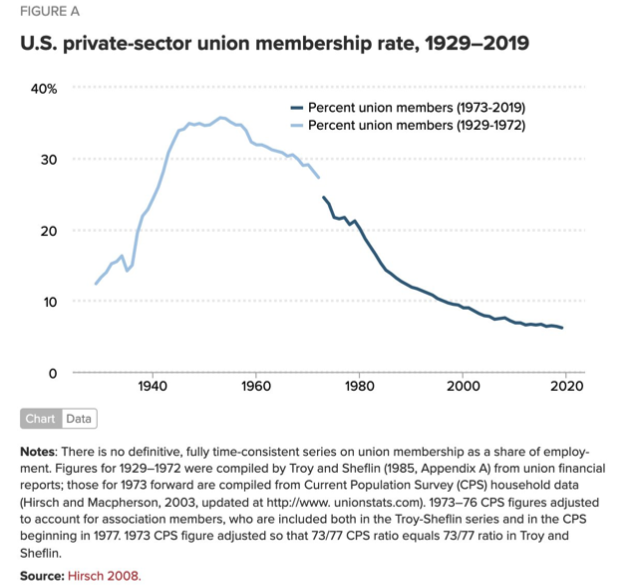 Sluggish Institutions in a Dynamic World: Can Unions and Industrial Competition Exist?
In tandem, productivity growth and workers’ pay have diverged, with productivity growing at 62% since 1979, while hourly compensation has only grown by 17.5%.
Translation: most productivity gains are going to capital, while workers are not sharing in this economic growth.
Despite the wins of unions, they have not been without controversy: until the Civil Rights movement, many unions systematically excluded workers of color. Some have been plagued with corruption and embezzlement of union funds by leaders, distorting their intended purposes.
And some critics point out that as unions became centralized bureaucracies in their own right, they often settled for too little — over the objections of their own members.
So how can we harness the power of collective action moving forward to ensure that labor’s voice is represented, while minimizing the centralized structures that can lead to a perversion of values?
The decentralized future of labor
New developments in decentralized coordination hold promise for a renewed pro-labor movement. Decentralized autonomous organizations (DAOs) — internet communities with shared ownership — can function akin to unions, representing the collective interest of their members to drive beneficial policies and mechanisms.
Take Yield Guild Games for example, a gaming guild composed of thousands of play-to-earn gamers. An onramp that brings more players into play-to-earn gaming, it can represent gaming and lobby game developers for better policies.
Its scale also enables the collective to offer benefits and protections (e.g. healthcare, paid time off) that would be infeasible if gamers were operating on their own.
DAOs like KlimaDAO can be viewed as experiments in macro collective action: individuals who share an interest in combating climate change are able to harness their power to raise the prices of carbon offsets — forcing companies and countries to respond faster to climate change.
Versus unions, the transparency of DAO governance and on-chain flows of capital lessens risk of embezzlement and corruption, since there is visibility into how funds are flowing into and out of the treasury. And open rules for member admission mitigate institutional discrimination.
According to this post about the path to DAOism, “since not every participant shares the same goal, colluding to make the outcome of the system favor specific participants is difficult.”
Anothing element driving worker power in decentralized organizations is the increased ability of contributors to freely exit and port their skills and attention elsewhere, boosting labor’s leverage.
If gaming scholars can easily be onboarded to new games or a protocol’s community can fork it and start anew, that creates greater incentives among developers to act in community-friendly ways.
Importantly, DAOs themselves represent an unlock in structurally prioritizing the interests of stakeholders, by virtue of being “owned” by its members. Many believe that DAOs will grow to become larger than the biggest corporations because of this alignment among members with the network’s growth.
Of course, DAOs will face their own set of challenges around scaling, governance, and balancing the interests of capital providers versus active contributors. But they represent a compelling new paradigm for stakeholder primacy that can create value and leverage for a new generation of workers.
***
Originally published on Twitter on November 18, 2021
Disclaimer
All information contained herein is for general information purposes only. It does not constitute investment advice or a recommendation or solicitation to buy or sell any investment and should not be used in the evaluation of the merits of making any investment decision. It should not be relied upon for accounting, legal or tax advice or investment recommendations. You should consult your own advisers as to legal, business, tax, and other related matters concerning any investment. None of the opinions or positions provided herein are intended to be treated as legal advice or to create an attorney-client relationship. Certain information contained in here has been obtained from third-party sources, including from portfolio companies of funds managed by Variant. While taken from sources believed to be reliable, Variant has not independently verified such information. Any investments or portfolio companies mentioned, referred to, or described are not representative of all investments in vehicles managed by Variant, and there can be no assurance that the investments will be profitable or that other investments made in the future will have similar characteristics or results. A list of investments made by funds managed by Variant (excluding investments for which the issuer has not provided permission for Variant to disclose publicly as well as unannounced investments in publicly traded digital assets) is available at https://variant.fund/portfolio. Variant makes no representations about the enduring accuracy of the information or its appropriateness for a given situation. This post reflects the current opinions of the authors and is not made on behalf of Variant or its Clients and does not necessarily reflect the opinions of Variant, its General Partners, its affiliates, advisors or individuals associated with Variant. The opinions reflected herein are subject to change without being updated. All liability with respect to actions taken or not taken based on the contents of the information contained herein are hereby expressly disclaimed. The content of this post is provided “as is;” no representations are made that the content is error-free.